A Brief History and a Lesson on the Mechanics of Crokinole
From someone who has never actually played the game.
Hi! I’m Fergus. I’m the self elected resident game mechanic expert at Taletech. This position naturally fell on me as I have no real programming or marketing skills, but have solemnly dedicated a great proportion of my life to playing board and video games. I’m now the guy that doesn’t do any programming but says ‘that’s not right’ or ‘that should be more like this.’ If the development of Bay 12 Game’s Dwarf Fortress has taught me anything, it’s that this is a real and very valid position.
As someone into board games and lists, it’s hard to not acknowledge that Crokinole has remained in Board Game Geek’s top 50 Games for several years now, and is by far the simplest game on the list by about 5 pages of rules. On the contrary, it remains one of the least accessible games to play on this list due to its price point with an average board costing around £300. This is the part where I have to embarrassingly admit that I have never physically played the game.
I had first learnt about the game after binge watching several of Shut Up & Sit Down’s reviews. Quinn did a better job than I will ever do at explaining the rules of the game, but here is my brief overview and thoughts.
Crokinole was invented sometime in the 1870’s in Canada. The word Crokinole likely derives from the french croquignole, which in Canada is a form of doughnut (hence the shape). The game is very similar to Carrom which is a disk flicking game similar to pool. Unlike both Carrom & Pool, the objective in Crokinole is to land your pieces towards the center, as opposed to pockets in the side.
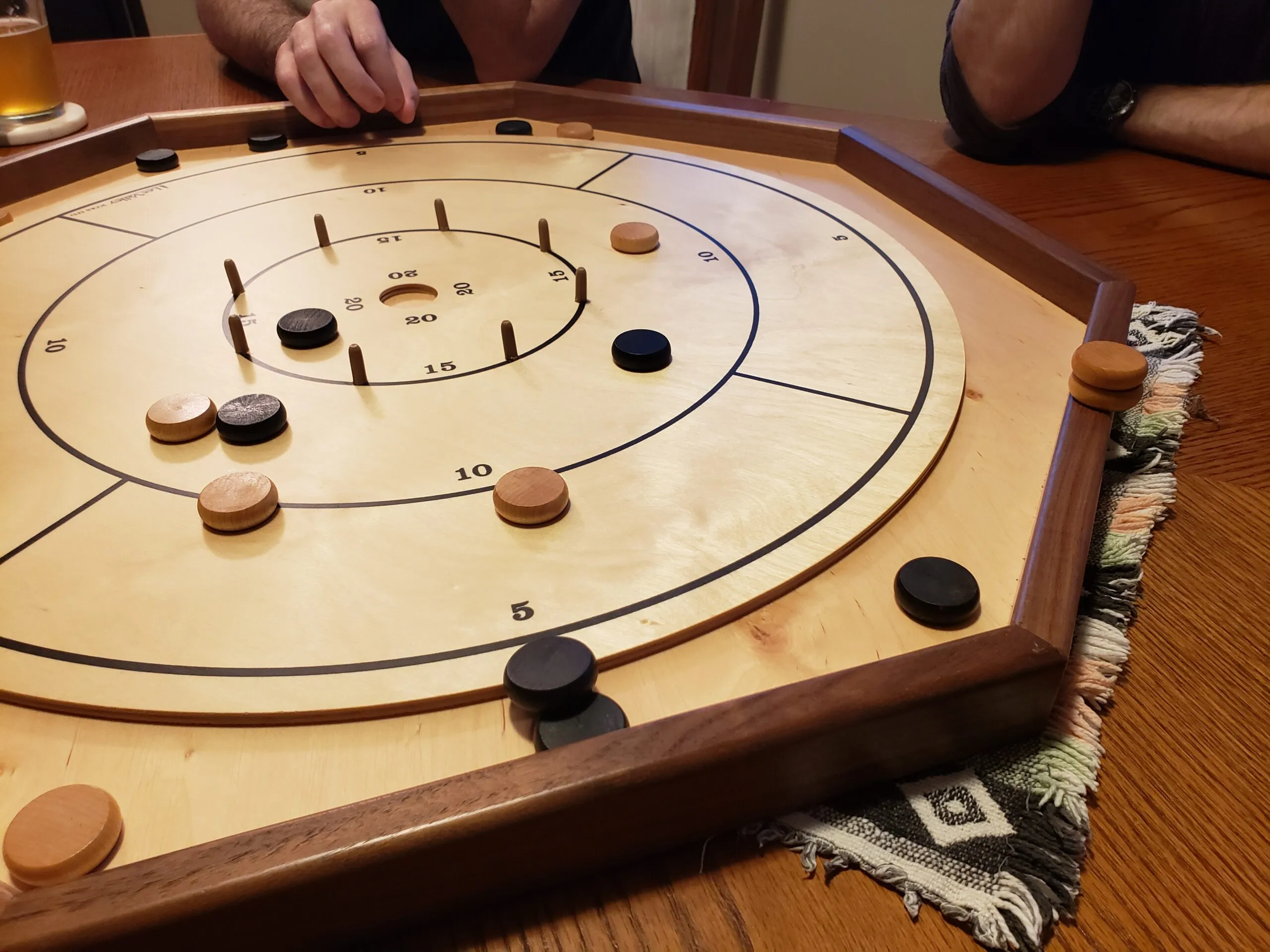
The board has 3 scoring zones, and a hole in the middle which scores you 20 points. 8 Pegs surround the central scoring zone which serve as a way to obstruct clean easy shots, and encourages daring shots where you either succeed your wildest flicking dreams, or fail miserably. A ditch surrounds the board which you can strategically knock your opponents discs into, or your own in the very same attempt.
The great thing about Crokinole’s central mechanic, is that if there is an opponent’s piece on the board, you must hit it with your own disc for it to be a legal shot. It makes the game incredibly ambitious, as you are constantly asking yourself “how can I hit my opponent’s piece, knock it off the board, and bag myself 20 points.” If you can’t already tell from my writing style, the beauty of this game is the swingyness between failure and succeeding. Although that’s what I assume it’s like from watching clips of the game.
Ultimately, I think there are two main reasons we wanted to adapt it into a video game. First was in an attempt to make the game more accessible to a wider audience, those who don’t have £300 of disposable income to spend on slabs of wood and lubricant powder. The other was that the game is so simple that it lends it to the kind of video game fuckery you can only do within the digital world. Games like Balatro are inherently simple at their core and based on simple principals like a deck of cards and poker hands. If you ask me, a game like Crokinole is begging for wondrous silly powers, different ways to improve your score, and cooky crazy visual effects. That being said, it might be at the cost of making a beautifully simple game overcomplicated. You’ll just have to keep following to see!
— Fergus